-255x255.jpg)
Saturday, April 21, 2012
Published on National Catholic Register!


Wednesday, April 18, 2012
Beauty vs. Technology
“Truly great must be
the value of human life if the Son of God has taken it up and made it the
instrument of the salvation of all humanity!” – John Paul II

Being bodily creatures, we experience and come to know
things through our physical senses. We’re wired that way. The body is God’s
greatest work of art and deserves nothing less than sheer wonder and awe at its
beauty. Not only is it created with systems that help it function, but it is a
marvel to see. Every body is beautiful, every body tells a story about the soul
that lives inside it.
So often, we live two extremes: either we are so
desensitized to the world’s objectification of the body that we no longer give
the body the value it deserves, or we turn away from beautiful bodies to avoid
temptation. There has to be a happy medium.
The first extreme shows the body is good, but doesn’t give
it its proper value. The second extreme shows the body to be bad. Both are
wrong. The body is good. While we should guard ourselves from temptation, we
nevertheless need to recognize and appreciate beauty when we see it, especially
in a person.
As shown in the Greeks' nude sculptures of bodies or the paintings in the Renaissance period, the body reflects the beauty of the divine, namely,
the soul, which is made in God’s image. Simply by being human, we are transcending
God Himself. We point our fellow man further to God because we are a reminder of His goodness and beauty. By becoming human Himself, He glorified our bodies even more,
since He shared in our humanity, in all its beauty and weakness.
But it doesn’t stop there! While the body is the most
magnificent work of art by a Creator who inspired all other arts, the person is
more than a body. He is a soul. A human person never dies, though his body will. Every soul has a purpose, and every soul has infinite value and is loved by the Creator. Generally, our culture has lost the sense of the
worth of the human person.
This is evident even in what we do when we “socialize”. For
example, if you go to a movie theatre and watch the crowd before the movie
starts, nearly everyone has their phones out. If eyes aren’t glued to
smartphones, they’re glued to a computer screen. We’ve lost touch with interpersonal
relationships. We have forgotten how wonderful people are, what we can learn from them and what we can give to them. We don’t worship a golden calf per se, but we practice idolatry
by sacrificing the human person on the altar of technology and progress with
the way we use our time. Technology is good, if used in moderation.
By nature, man is a social being and cannot develop gifts if he lives
in solitude within himself. Meaning, if he's glued to his technology, he's not developing relationships, or himself. Like the ripple affects the entire body of water,
so our interactions with others affect the entire brotherhood of humanity. Once in
a while, take a break from technology. Turn off that phone, close that computer
and have a meaningful conversation with someone. Who can compare "stuff" with the marvelous beauty of the human person?
Case and point: BlimeyCow’s video on Smartphones and how
they make us lazy. I’m afraid it’s too true.
Monday, March 26, 2012
The Hunger Games Review
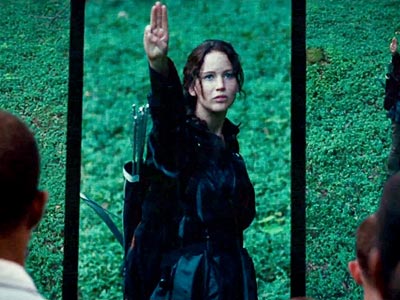 |
| Jennifer Lawrence as Katniss gives a sign of honor to District 11 |
“I want to show them they don’t own me. If I’m going to die
– I want to still be me.”
Those are some pretty chilling, yet gutsy words for young
adult fiction. The Hunger Games, which has sparked a frenzy like other
fantasies such as Harry Potter and Twilight, (though I hate bringing those
up, since the stories are completely unlike Hunger
Games), has turned into a film franchise with just as much potential.
For those of you still unfamiliar with the story, The Hunger Games is set in
post-Apocalyptic America, which is separated into 13 districts and afflicted
with nation-wide hunger. Now named Panem, a frighteningly tyrannical government
called The Capitol controls the districts with an iron fist. To remind the people
of their control, they annually pick a girl and boy from every district, throw
them into an arena, and force them to kill one another. The sole victor wins
food for his family for the rest of his life.
Every district and oblivious Capitol citizen watches the
Games on nationwide television; those who are wealthy enough can sponsor their
favorite “tributes” by sending them gifts, which help them stay alive…for a
while.
Katniss Everdeen, the heroine of the story, is a quiet, feisty
girl who illegally hunts in the forest to provide for her family. When her
younger sister, Prim, is chosen for the Games on “Reaping” day, she volunteers
to be the tribute instead. She and the gentle Peeta Mellark are thrown into the
Games and the Captiol world, where citizens are completely desensitized to the suffering
districts around them. They are blinded by their obsession with fashion,
entertainment and violence at the tributes’ expense. Rhetoric slews from their
politicians in slimy terms like, “this shows sacrifice…it brings us together” –
which is not unlike our own politicians’ rhetoric.
What follows is a violent survival story, mixed with comical
characters like Effie, District 12’s ridiculous Capitol manager of sorts, and
Haymitch, Peeta and Katniss’s mentor. What gives the story its depth is its heroine,
making self-sacrificing choices, enkindling her nation with hope about changing
the regime, and the realization that human life is sacred. Even in the darkest
of times, the main characters hold onto their humanity, even though they’re
scarred. In addition, there are several beautiful relationships, such as
Katniss and Prim’s loving, sisterly relationship; Rue, Katniss’s timid ally
from District 11; and Peeta, who loves Katniss, even though she doesn’t
actually love him back.
The story is intense and keeps a fast pace both in the books
and in the movie. The 2.5 hour running time seemed to be just 40 minutes. It
had me teary-eyed, smiling, on the edge
of my seat, and then jumping out of my seat. It was well-done story-telling to
say the least.
The choice of actors in the film made fans skeptical
initially, but in the film proved to be perfectly chosen. While Katniss didn’t
look exactly like she was described in the book, Jennifer Lawrence effectively captured
Katniss’s personality and heart. Stanley Tucci, who played the Games host, was
perfectly animated and charismatic. Woody Harrelson made a perfect drunkard
that still had a caring heart and witty sense of humor. Elizabeth Banks, who
played Effie, looked and acted perfect. Josh Hutcherson, as Peeta Mellark, practically
stole the show. Though not as big or tall as the book’s character, he
fit the role to a tee, embodying Peeta’s gentle, self-sacrificing essense and
likeable personality.
Not only is the acting spot on and the story of The Hunger Games riveting, but the movie
was filmed in a artistic way that fit the movement and tone of the book.
Director Gary Ross believed that a handheld camera was a necessary element that
fit the raw emotion of the film. He said, “If I made a glossy,
slick, kind of overproduced piece of entertainment, then...I’m basically
staging the Hunger Games…If you try to create a piece of entertainment
that indulges the premise…you’re going to end up really losing the point and
the heart of the book." Some viewers challenged the use of swish pans,
closeups and quick, jerky camera movements – but artistically, I believe it
stresses Katniss’s point of view.
Overall, the film is well-made and is very faithful to the
book. In terms of faithfulness and quality, I compare it to the first Narnia
movie, The Lion, the Witch and the
Wardrobe. Some fans found the minor changes that were made annoying, but
that’s going to happen with any book-turned-movie. Tom Bombadil wasn’t in Lord of the Rings either, but they were
still faithful and fantastic movies.
Some, if not many, will overlook the deeper elements and
themes of the story, so I want to explore them. The Hunger Games in an
unsettling story. Unsettling because it deals with young people beating each
other to death – something that goes against our nature. This discomfort has a
purpose: it warns us that, in our current society, which is so engrossed in
entertainment, especially “reality TV”, we have become desensitized to that
which harms our humanity. We no longer give second thought to shows about destroying
another person, even if it’s only through gossip. We have become so focused on
being entertained that we forget the importance of real relationships in our
life and the real problems we face today. Even worse, we’ve become indifferent
and lazy – we’ve become afraid to say something and make a change in response
to problems we see. We continue to push God out of our public society. What if
He completely disappeared from the public sphere? What would happen to the basic
moral codes that are written in the hearts of man? Our government has lost its
founding principles and is slowly forcing mandates on us without our approval. What
will happen if we don’t do something about it? The Hunger Games is an exaggerated foreshadowing of what our
culture could become if we do not
speak up, if we do not do something to alter the path where our society is
headed.
Through the darkness of The
Hunger Games, through its Godless culture, and through the horrendous attack
of human life in the story, it shows us there is still truth and beauty. The story shows the intrinsic truth that human life is sacred, because the violence is not glorified. The characters are suffering victims that choose to do something about the injustice they face. Through this, the story shows the beauty of
meaningful, self-sacrificing relationships. It’s about holding onto humanity
and making the right choices, even if it means losing our lives. While its
themes are dark, it is supposed to shock us out of our indifferent attitude
towards our culture. It is not unlike those heart wrenching, dark stories such
as Schindler’s List, where humanity
seems all but lost; like Schindler’s, it nevertheless shows that
despite the most difficult and horrifying circumstances, we can hold on
resiliently to our humanity, which is the greatest gift of all.
Having said this, it is important to note that The Hunger Games is probably best suited
towards more mature audiences – both the movie and especially the books.
Parents should discuss these deeper themes with their kids, because if they’re
not able to discern it themselves, readers might end up becoming that which is
warned of in the story – a society like the Captiol civilians, who are
desensitized to the violence, injustices and Godless culture that surrounds
them.
Tuesday, February 28, 2012
"The Vow": Classic Ephesians 5

In a country where the divorce rate is a whopping fifty
percent, it seems we have lost our sense of faithfulness to one another, and
most of the time, films reflect that - which is why The Vow is so refreshing to see.
Starring Channing Tatum and Rachel McAdams, The Vow shows the beauty of a faithful
marriage when loving a person isn’t easy. Leo and Paige are a newly married
couple who end up in a car crash, resulting in Paige’s memory loss, and their
vows are tested to their limits.
Leo is a heroic husband amid the tragedy, sacrificing his
money and business to help Paige remember the last four years of their life
together. In Paige’s mind, she is still engaged to her previous guy and is in
law school instead of an art institute.
Despite Paige’s difficult situation, Leo upholds his role as
an Ephesians 5 husband.
“Husbands, love your wives, just as Christ also loved the church and gave Himself up for her.”
Although the Christian aspect of the
true story isn’t in the film, Leo still lays down everything to help his wife
through her confusion and pain. Even with his goodness, he’s still human, and
at one point reminds Paige that she still needs to respect him as he tries his
best to love her even when she’s difficult to love.
Leo never stops pursuing his wife. When
Paige’s memory doesn’t return, he decides to try to make her fall in love with
him again. He tells her, “You know when you read a good book, and you want a
friend to experience the same excitement you had? Well, our life together was
really great, and I want to share it with you, as if I’m lending you a book. So
how about one date?”
Paige struggles with remembering the
person she was when the accident happened, and it causes her to drift away from
Leo until she remembers why she made those decisions in the first place. She
ends up making the same decisions again, this time, after making peace with the
broken relationships in her family.
While Leo’s self-sacrificing love is a
beautiful example, in the end, it isn’t Leo and Paige’s marriage that is the
best example of faithfulness to their marriage vows: it’s her parents, broken
and imperfect. The most touching moment in the movie is when her mother shares
why she never left her husband after he had an affair.
With tears running down her face, she tells Paige, “I chose to stay with him for all the things he did right, instead of leaving him for the one thing he did wrong. I chose to forgive him.”
As romance movies go, this one is
surprisingly deep in an industry that thrives on stories about superficiality
and infidelity. The script had some great lines, and while Channing Tatum and
Rachel McAdams weren’t their best, they had tremendous depth and emotion in
their characters. Overall, the film isn’t perfect, but the message is worth the
viewing.
This film shows the beauty of
self-sacrifice in marriage, and that real love involves a daily choice. Real
love is willing the goodness of another more than your own needs. Despite
faults and failings, real love is to choose to love one another – especially in
the times where the warm, romantic feelings are absent. Sometimes it isn’t
pretty, but in the end, faithfulness is always worth it.
Saturday, February 18, 2012
Adele Deserves Every Grammy She Got!
Adele's soulful pipes are mindblowlingly beautiful. Check out her performance at the Grammy's!
Tuesday, February 7, 2012
Extremely Loud and Incredibly Close Review
9/11 is still a touchy subject, still too close for comfort. So any
movie based on the event has heart-tugging potential, since every
American was wounded that day, some more than others.
Oskar Schell lost more than others. In the book-turned-film Extremely Loud and Incredibly Close, young Oskar lost his father in the Twin Towers on 9/11, or “The Worst Day”, as he calls it.
Having been raised by a wonderful father played by Tom Hanks, Oskar took his father’s death quite hard, though he doesn’t let it harm his earnest spirit. Oskar is the most persevering son/amateur pacifist/vegan/oxymoronist/martial artist/inventor, who will stop at nothing to find answers.
Oskar’s father taught him to search, to dive into his curiosity. Oskar will relentlessly search for the pieces of the puzzle that satisfy the questions of his heart. So when Oskar finds a key in his father’s room with the name “Black” on it, Oskar believes his father intended that he find what the key unlocks.
The journey sends Oskar on a wild goose chase, since there are over 400 people with the name of “Black” in one region of New York alone. Oskar even employs the help of an elderly man who can’t speak to help him, and learns from him the art of letting go.
Note that for this movie, as it is often in life, the point isn’t about the destination, as it is the journey. Along the journey, Oskar learns about himself, his family, and about loving family relationships. Most importantly, he learns that it’s okay to be sad and to hurt. It’s also ok to move on. At some point, we have to let go to move toward the future.
While the premise of the story is initially touching and relatable, the intense dramatization is a bit too much to bear without any happy moments mixed in. With such a heavy subject, the movie needed to be more balanced; it was all depression, all time, until the last few minutes.
Sandra Bullock and Tom Hanks, who played the Schell parents, were raw and genuine. Their loving natures were believable, and their gestures and mannerisms unique. Thomas Horn, who played Oskar, was a bit too over the top personally, although in certain scenes in the movie, his emotion was spot-on.
While 9/11 is a heavy subject, it seems that the event and the people surrounding it should be portrayed in a hopeful light to reflect that, as a nation, we have let that grief go. 9/11 will never be forgotten. But I don’t think those who were lost would want us to wallow in depression, so Extremely Loud and Incredibly Close shouldn’t, either. We shouldn’t focus on the pain, but rather let its memory propel us forward, motivating us to live each day to the fullest.
Check out this movie review on Extremely Loud and Incredibly Close featured at MyBenedictineBlog.com!
Oskar Schell lost more than others. In the book-turned-film Extremely Loud and Incredibly Close, young Oskar lost his father in the Twin Towers on 9/11, or “The Worst Day”, as he calls it.
Having been raised by a wonderful father played by Tom Hanks, Oskar took his father’s death quite hard, though he doesn’t let it harm his earnest spirit. Oskar is the most persevering son/amateur pacifist/vegan/oxymoronist/martial artist/inventor, who will stop at nothing to find answers.
Oskar’s father taught him to search, to dive into his curiosity. Oskar will relentlessly search for the pieces of the puzzle that satisfy the questions of his heart. So when Oskar finds a key in his father’s room with the name “Black” on it, Oskar believes his father intended that he find what the key unlocks.
The journey sends Oskar on a wild goose chase, since there are over 400 people with the name of “Black” in one region of New York alone. Oskar even employs the help of an elderly man who can’t speak to help him, and learns from him the art of letting go.
Note that for this movie, as it is often in life, the point isn’t about the destination, as it is the journey. Along the journey, Oskar learns about himself, his family, and about loving family relationships. Most importantly, he learns that it’s okay to be sad and to hurt. It’s also ok to move on. At some point, we have to let go to move toward the future.
While the premise of the story is initially touching and relatable, the intense dramatization is a bit too much to bear without any happy moments mixed in. With such a heavy subject, the movie needed to be more balanced; it was all depression, all time, until the last few minutes.
Sandra Bullock and Tom Hanks, who played the Schell parents, were raw and genuine. Their loving natures were believable, and their gestures and mannerisms unique. Thomas Horn, who played Oskar, was a bit too over the top personally, although in certain scenes in the movie, his emotion was spot-on.
While 9/11 is a heavy subject, it seems that the event and the people surrounding it should be portrayed in a hopeful light to reflect that, as a nation, we have let that grief go. 9/11 will never be forgotten. But I don’t think those who were lost would want us to wallow in depression, so Extremely Loud and Incredibly Close shouldn’t, either. We shouldn’t focus on the pain, but rather let its memory propel us forward, motivating us to live each day to the fullest.
Check out this movie review on Extremely Loud and Incredibly Close featured at MyBenedictineBlog.com!

Tuesday, January 10, 2012
How "The Help" Isn't So Different Today...
"Those who forget history are destined to repeat
it."

In World War II, Adolf Hitler claimed Jews were not human
beings. He brutally massacred them in The Holocaust. He sent them to
concentration camps and committed horrendous crimes against them – unspeakable things.
He tore their families apart.
Not too long ago in our American history, we claimed blacks
were not people and treated them as property - or worse - similar to what
Hitler did to the Jews.
In the recent book-turned-movie, The Help, we get a better taste of how white people treated black
people. And look how far we’ve come – we had the Civil Rights movement, led by
people like Rosa Parks and Martin Luther King, Jr. We’ve come a long way. While
we still deal with racism, people of different color and creed are treated as
equals now.

This movie was celebrated by critics. People who know the
story agree it’s good. People know that it’s unjust to claim that other people
are not human.
We’re American. We’re all about equality.
Or are we?
We have a new Holocaust on our hands, another claim of
inequality, another horrendous injustice. By our votes, we legalized killing
innocent babies in the womb, which is supposed to be the safest place.
We claim they are not people, and have no right to life -
it's their mother's choice, not theirs. And they don't even have a voice to
speak up and say they want to live. They can't even scream.
Yet, science proves they have a heartbeat only a couple
weeks after conception. At the moment of conception, they have the 46
chromosomes that make up a human person. Scientifically, they are persons.
So is there any good reason
for killing an innocent child? Inconvenience, maybe? Grow up and take
responsibility for your actions. How about rape? Does the crime of rape make it
okay to commit another crime of murder? It’s not the child’s fault.
When will we learn? How many more lives need to be claimed
in the name of inconvenience, or “because of certain circumstances”?
We were born into the beautiful community of humanity – we are
all equal and we are supposed to look out for each other, especially the innocent and those who cannot speak for themselves.
Who are we to say they have no right to life? If we do, that
makes us no different from Hitler. If you say, “It’s her choice, not mine”, it’s
no different than saying, “It’s Hitler’s choice, not mine”.
This kind of inequality is no different than a racist view –
it’s worse. It’s threatening the entire human race, not just one kind.
We have blood on our hands, America. If we want to make a
change, stop sitting on the fence and DO SOMETHING ABOUT IT.
And it can be done. In The
Help, Skeeter did something about the injustice she saw. One of my favorite
scenes is where Skeeter’s mother tells her how proud she is of her daughter,
that she had the courage to go against the tide, take a stand for what’s right
and write the book. “Sometimes courage skips a generation,” she says.
I decided that I will be that generation that says, “Enough
is enough”.
I will not be silent. I will not be apart of our culture of
death, apart of those who stand by idly and watch innocent lives die. I will
not be claimed or owned by the world, who repeats its mistakes over and over. I
will fight for life, even if it means losing my own.
Subscribe to:
Posts (Atom)